Carrier Gas Furnaces in Pasadena
In plain terms: Pasadena Carrier HVAC services and installs Carrier gas furnaces across Pasadena, from Garfield Heights to Madison Heights 91106, working the 59MN7 modulating, 59TN and 59TP 2-stage, 59CU5 Ultra-Low NOx, and 58-series 80% furnaces. Call (213) 513-5436 or book online to decode flash codes 13 through 34 and book a repair.
The short version
- 59-series condensing: 59MN7 modulating (~98 AFUE, variable-speed ECM), 59TN7/59TN6 2-stage, 59TP6 Performance, 59SC6 Comfort, 59CU5 Ultra-Low NOx.
- 58-series 80% AFUE (58TN/58TP/58SC) - common and sensible in Pasadena's mild climate.
- Flash codes: 13/33 limit, 14 ignition lockout, 31 pressure switch, 34 ignition-proving, 26 rollout, 24 control fuse.
- Key parts: hot-surface igniter, flame sensor, inducer motor, pressure switch, rollout/limit switches, gas valve, control board, ECM blower.
- California Ultra-Low NOx emissions rules shape replacement model choice.
- Service area Pasadena ZIPs 91101-91107. In-warranty units to authorized service first.
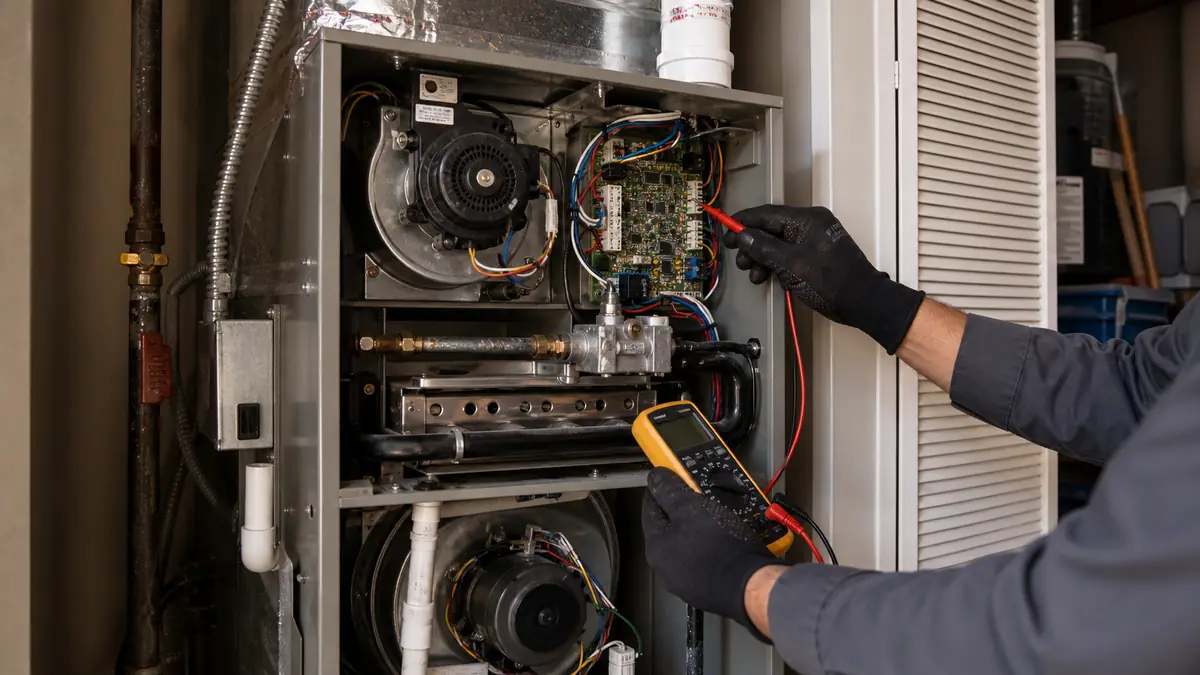
Which Carrier furnace lines turn up in Pasadena?
Pasadena attics and closets hold a wide spread. The top of the line is the 59MN7 Infinity 98, a modulating furnace with a variable-speed ECM blower near 98% AFUE. Two-stage 59TN and Performance 59TP units sit in the middle, and the 58-series 80% furnaces are still very common because the short heating season rarely justifies condensing efficiency. The 59CU5 Ultra-Low NOx variant matters because California emissions rules govern what you can install.
| Model family | Efficiency / trait | Pasadena fit |
|---|---|---|
| 59MN7 (Infinity 98) | Modulating, ~98 AFUE, variable ECM | Comfort-first, longer heating use |
| 59TN / 59TP | 2-stage, ~96 AFUE | Balanced upgrade |
| 59CU5 Ultra-Low NOx | Meets CA emissions rules | Required-emissions replacements |
| 58-series | 80% AFUE, no condensate | Mild-climate value, simple venting |
Carrier furnace model-by-model: what each one fits
The 58 and 59 prefixes split the line by efficiency and venting, and the right one depends on how much you actually heat:
- 59MN7 (Infinity 98). Modulating gas valve plus a variable-speed ECM blower, near 98 AFUE. The quiet, comfort-first choice; the variable blower also pairs well with a Greenspeed AC or heat pump for even airflow. Best where heating use is real and budget allows.
- 59TN7 / 59TN6 (Infinity 97 / 96) and 59TP6 (Performance 96). Two-stage, variable-speed, mid-90s AFUE. A balanced upgrade that ramps between a gentle first stage and full output.
- 59CU5 (Infinity 95 Ultra-Low NOx) and 59SC6 (Comfort 96). Single-stage condensing. The 59CU5 is built to meet California's nitrogen-oxide limits, which is why it shows up on Pasadena replacements where the rule applies.
- 58-series (58TN / 58TP / 58SC) 80% AFUE. Non-condensing, simple metal-flue venting, no condensate drain. Still very common and sensible here because Pasadena's short heating season rarely repays condensing efficiency, and the simpler venting suits older closets and attics.
How do you decode a Carrier furnace flash code?
The control board flashes a numeric code through the cabinet LED. We read it, then verify the ignition sequence stage by stage: inducer spin-up, pressure switch closing, igniter glow and resistance, gas-valve opening, and flame sense in microamps. A flame sensor below roughly 1 microamp will not hold the valve, so cleaning it fixes many "dead" furnaces. The full code list and step-by-step diagnosis live on the Carrier fault codes page.
| Code | Meaning | Component to check | Cost lane |
|---|---|---|---|
| 13 / 33 | Limit circuit lockout / fault | Airflow: filter, return, blower, limit | $120-$600 |
| 14 | Hard ignition lockout | Igniter / gas valve / flame sensor | $200-$900 |
| 24 | Control fuse open | Shorted low-voltage wire / transformer | $120-$400 |
| 26 | Rollout switch open | Heat exchanger / flue (safety) | Diagnose first |
| 31 | Pressure switch fault | Inducer / blocked flue or condensate | $200-$700 |
| 34 | Ignition-proving failure | Weak igniter / dirty flame sensor | $150-$400 |
| 45 | Control circuitry lockout | Integrated furnace control board | $300-$900 |
What does installing a Carrier furnace involve in Pasadena?
The catch in older Pasadena homes is venting and access. A condensing 59-series unit (90 percent and up) produces acidic condensate and needs PVC intake and exhaust venting plus a drain - not every 1920s closet or attic has a path for that, and adding one can drive the job up. An 80% 58-series unit reuses simpler metal-flue venting, which is one reason it stays popular in the historic core. California's Ultra-Low NOx emissions rules also narrow the model list on any replacement, so a like-for-like swap is not always allowed. Where a furnace shares a tight closet with the air handler, access alone adds labor on a board or blower job. We confirm the venting path, the gas line and electrical, and the emissions requirement before quoting, so the install clears inspection the first time.
Condensing 59-series or 80% 58-series: which makes sense here?
The honest answer in Pasadena is "it depends on your heating hours." A 96-98% condensing 59-series furnace burns less gas per hour and is the comfort leader, but it costs more, needs PVC venting and a condensate drain, and over a short Zone 9 heating season the fuel savings take many years to repay the premium. An 80% 58-series costs less, vents simply, and fits older homes with minimal modification - a rational pick where the furnace runs only on the coldest foothill mornings. The deciding question is usually whether you are also pairing it with high-efficiency cooling and how long you plan to stay; we run both numbers rather than defaulting to the priciest unit.
What are the combustion-safety codes to respect?
A rollout switch trip (code 26) and repeated high-limit lockouts (13/33) can signal a cracked heat exchanger or a blocked flue. We test for flue-gas spillage and inspect the exchanger before clearing the fault rather than just resetting power. On older 80% units that show a cracked exchanger, we red-tag the furnace and lay out repair versus replacement honestly. For repair details, see furnace repair.
Repair, replace, or convert?
A bad igniter on a 5-year-old 59MN7 is a fast fix. A 20-year-old 58-series carrying a failed gas valve or a cracked exchanger usually tips toward replacement, and that is the moment a heat-pump conversion can both open up rebate eligibility and take gas combustion out of the house. You get both numbers from us. The SEER2 and rebates guide lays out the current incentive caveats.
Common questions
What AFUE furnace makes sense in mild Pasadena?
An 80% AFUE 58-series furnace is common and reasonable here because Pasadena's heating season is short. A 96-98% condensing 59-series unit saves gas but needs PVC venting and a condensate drain, which not every older home has. We weigh the payback against your actual heating hours, not a national average.
Why does California require Ultra-Low NOx furnaces like the 59CU5?
Southern California air-quality rules limit nitrogen-oxide emissions from gas furnaces, so models like the Carrier 59CU5 Ultra-Low NOx are designed to meet them. When we replace a furnace in Pasadena, the new unit has to satisfy the current emissions standard, which narrows the model choice.
My 59-series furnace flashes a code. Can I read it myself?
Yes. Through the cabinet sight glass the control LED flashes a numeric code: 13 or 33 limit circuit, 14 ignition lockout, 31 pressure switch, 34 ignition-proving, 26 rollout. Count the flashes and match them to the code list. A 26 rollout means stop and call, since it points at a combustion-safety problem.
Should I keep my gas furnace or switch to a heat pump?
If the furnace is healthy, keeping it as dual-fuel backup behind a Carrier heat pump is efficient and cheap. If it is failing and out of warranty, a heat-pump conversion may qualify for electrification rebates and removes combustion entirely. We give both numbers; Pasadena's mild winters make either path workable.