Weak Airflow From Vents in Pasadena
In plain terms: Weak airflow on a Carrier system in Pasadena 91101 to 91107 usually traces to a clogged filter, leaky or undersized ducts, a failing ECM blower, or an iced coil flagging code 44. Call Pasadena Carrier HVAC at (213) 513-5436 or book online and we measure static pressure to find the real bottleneck.
The short version
- Top causes: dirty filter, leaky or undersized ducts (common in 1920s homes), failing ECM blower, iced coil, closed returns.
- Carrier code 44 flags excessive air-delivery restriction.
- We measure static pressure and room-by-room airflow before recommending parts.
- Cost lanes: filter/return $0-$120; duct seal/resize $500-$3,500; ECM blower $450-$2,300.
- Iced coil points to dirty filter or low charge, not always a blower fault.
- Service area Pasadena ZIPs 91101-91107.
What causes weak airflow on a Carrier system in Pasadena?
Airflow is a chain: return grilles, filter, blower, coil, ducts, supply registers. A restriction anywhere weakens the whole house. In Pasadena's older homes the duct system is the usual weak link, because ducting was retrofitted into Craftsman crawlspaces and attics with undersized trunks and leaky boots. The fixes range from a $20 filter to a duct rebuild, so we measure before we quote.
| Symptom | Likely cause / first check | Cost lane |
|---|---|---|
| Weak everywhere, recently changed | Clogged filter or closed returns | $0-$120 |
| One room weak, rest fine | Crushed, leaky, or undersized branch duct | $300-$1,500 |
| Frost on coil or suction line | Low charge or dirty coil; code 44 | $225-$1,500 |
| Blower runs slow or cuts out | Failing ECM module or motor | $450-$2,300 |
| Whistling, high static pressure | Undersized returns or trunk | $500-$3,000 |
What can I check before calling?
Replace the filter if it is more than a month into a heavy cooling stretch, and make sure no return grilles or supply registers are blocked by furniture or closed. If you see frost on the coil or the copper suction line, turn cooling off and run the fan only to thaw it, then leave it off until we look; running an iced system risks the compressor. These two steps clear a good share of weak-airflow calls outright.
How do you find the real restriction?
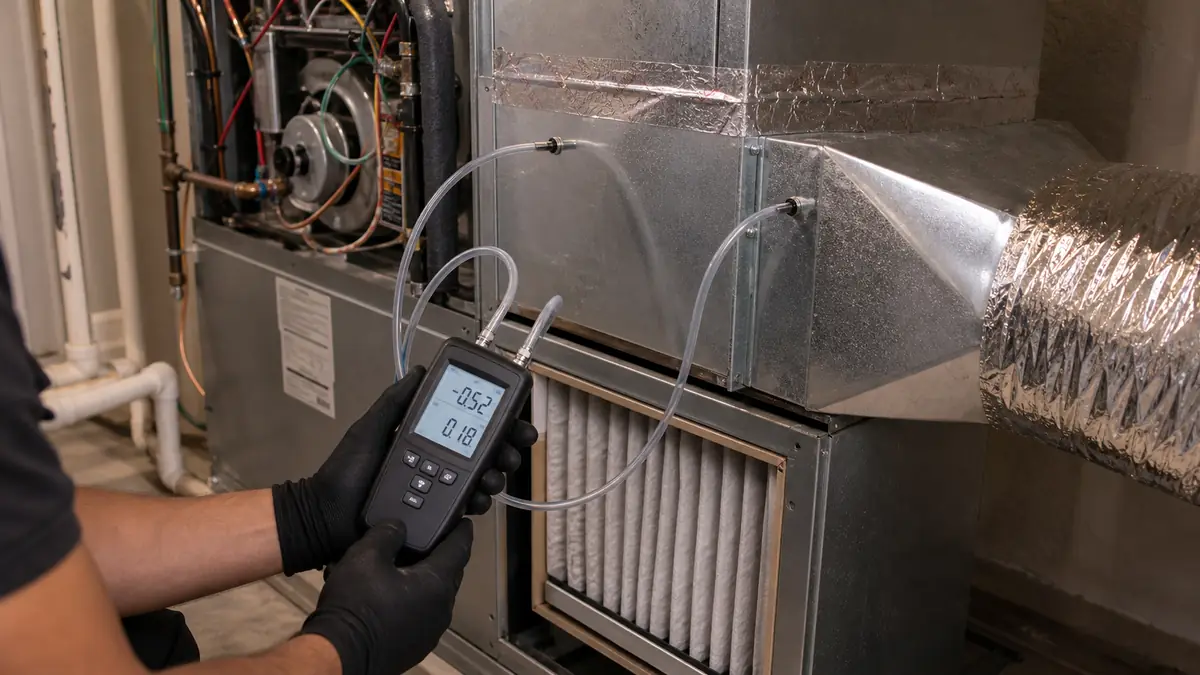
We put a manometer on the air handler to read total external static pressure, then measure airflow at registers room by room. High static with clean filters means the ducts or coil are the limit; low airflow at one register isolates a bad branch. That reading points to a duct repair and seal, a coil cleaning, or a blower or refrigerant repair, instead of guessing.
We chase a weak-airflow complaint through a deliberate progression, never jumping ahead. First we read total external static pressure across the air handler with the blower running; most residential Carrier systems are designed around about 0.5 inches of water column, and a reading of 0.8 or higher confirms a real restriction rather than a perception. Next we split that number into the return side and the supply side, because a high return static points at undersized return grilles or a crushed return drop, while high supply static points at the coil, a clogged filter, or pinched supply branches. Then we read the temperature split across the indoor coil: a split wider than about 22 F with weak flow signals airflow starvation that can frost the coil, while a narrow split with weak flow points more to a charge or compressor issue. Only after those numbers do we pull the blower data, reading the ECM motor's commanded versus actual RPM at the Infinity control.
When is it the ECM blower itself?
A true Carrier ECM blower fault is less common than homeowners expect, but it does happen. The variable-speed ECM motor on a 59-series air handler or furnace ramps its RPM to hold a target airflow against whatever static the ducts present, so a healthy motor masks a worsening duct problem by simply working harder until it cannot keep up. When the motor module fails, you see airflow that surges and drops, a blower that cuts out and restarts, or a unit that runs but moves almost no air with no static-pressure cause. We confirm by reading the commanded airflow against measured airflow and checking the module for heat damage and capacitor swelling. An ECM module or motor replacement runs the $450 to $2,300 lane depending on whether the module alone or the full motor is gone, and on a communicating system we verify the Infinity control is calling for the right airflow stage before condemning the motor.
Common questions
Why is airflow weak in my back bedroom but fine near the thermostat in my Pasadena bungalow?
Room-to-room imbalance in a 1920s home almost always points to ducts: an undersized or crushed branch, a disconnected boot in the crawlspace, or a leaky run dumping air into the attic before it reaches the far room. It is rarely the Carrier blower itself when the front of the house cools normally.
Could weak airflow be a frozen coil on my Carrier AC?
Yes. A dirty filter or low refrigerant can let the indoor coil drop below freezing, and ice blocks airflow. Carrier code 44 flags excessive air-delivery restriction. If you see frost on the suction line or the coil, shut the system to cool mode off with the fan on so it can thaw, then call before running it again.
Does a variable-speed Carrier blower fix weak airflow?
An ECM variable-speed blower can push against higher static pressure than an old PSC motor, but it cannot fix undersized or leaky ducts; it just works harder and wears faster. We measure static pressure first. If the ducts are the limit, sealing and resizing helps more than a new blower.
How fast should I act on weak airflow during a Pasadena heat wave?
If the system still cools, it is same-week, not an emergency. But weak airflow that comes with ice or a tripping breaker can damage the compressor, so during a 100 F Santa Ana stretch we move those calls up. Replace the filter and clear return grilles before we arrive.