Pasadena HVAC Maintenance Calendar for Carrier Systems
Last updated: 2026-06-13
In plain terms: A Carrier maintenance year in Pasadena 91101 to 91107 revolves around the summer cooling load, built on a March-April tune-up and filter changes every one to three months. Call Pasadena Carrier HVAC at (213) 513-5436 or book online to run the coil rinse, drain flush, and fall furnace check on a plan.
The short version
- Climate Zone 9 is cooling-dominant, so the spring AC tune-up is the most important visit of the year.
- Filter changes every 1-3 months; more often during heat waves or with pets.
- March-April: full cooling check before the first 90 F-plus stretch.
- Summer: keep the condenser clear of debris; watch for clogged condensate drains.
- Fall: light furnace check (igniter, flame sensor, pressure switch) before the first cold morning.
- Annual documented maintenance helps keep Carrier parts-warranty conditions met.
Why does Pasadena's calendar revolve around summer?
Pasadena sits in Title-24 Climate Zone 9, a cooling-dominant inland basin where the San Gabriel foothills trap heat against the city. July highs run 88-92 F, roughly 25 to 40 days a year hit 90 F or above, and Santa Ana wind events push spikes past 100 F. That means your Carrier system earns its keep as an air conditioner, and the parts that fail, capacitors, contactors, condenser fan motors, and condensate drains, all fail from summer heat and runtime. So the maintenance year is built to get the cooling side bulletproof before the heat arrives, with a lighter touch on the short heating season.
What is the month-by-month schedule?
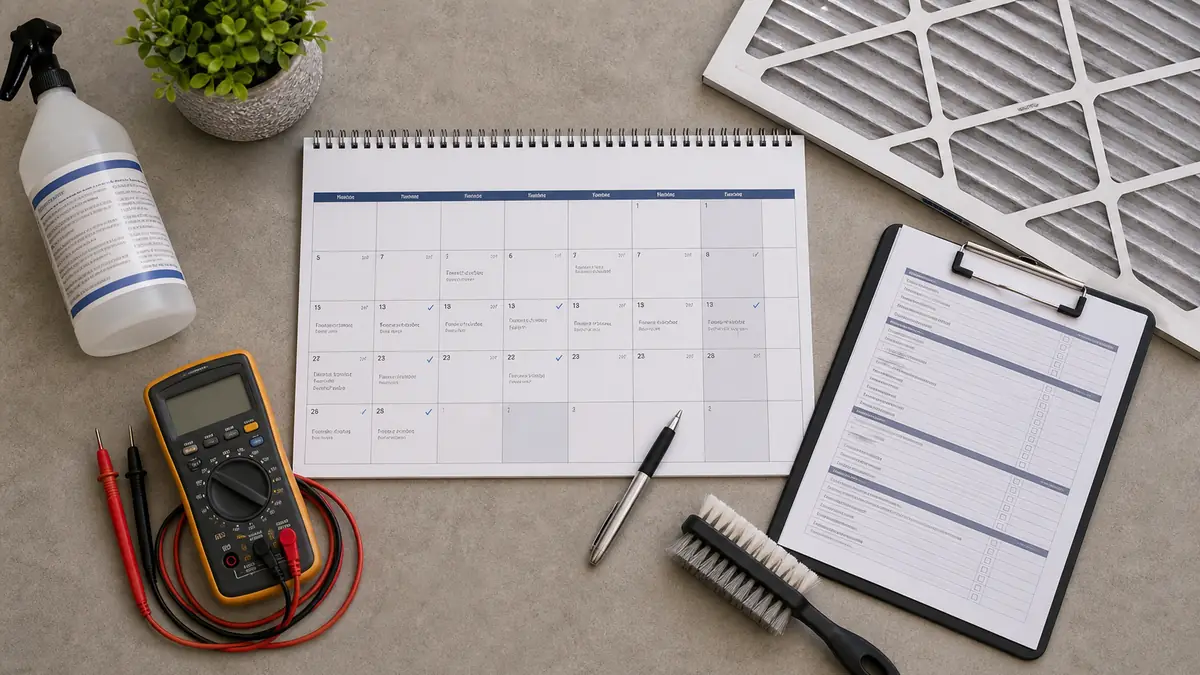
The table below is the working calendar we use for Pasadena homes. Adjust filter frequency up if you run the system hard or have pets, and move the spring visit earlier if a warm February hints at an early summer. The goal is to never discover a weak capacitor for the first time on the hottest afternoon of the year.
| Season | Do this | Who |
|---|---|---|
| Jan-Feb | Change filter; confirm heat works on a cold morning; clear condenser of leaf debris | Homeowner |
| Mar-Apr | Full cooling tune-up: capacitor, contactor, charge, coil rinse, drain, float switch | Technician |
| May | Fresh filter; test-run AC before heat; check thermostat schedule | Homeowner |
| Jun-Aug | Filter every 1-2 months; keep condenser clear; watch for water/leaks at indoor unit | Homeowner |
| Jul (peak) | If no-cool or noise, call early in the day during Santa Ana spikes | Both |
| Sep-Oct | Light furnace check: igniter, flame sensor, pressure switch, inducer | Technician |
| Nov-Dec | Change filter; verify heat; pull stored fault history on Infinity systems | Both |
What does a cooling tune-up actually check?
A real spring visit is measurement, not a quick look. We test capacitor microfarads against the nameplate, inspect the contactor for pitted contacts, take suction and liquid pressures and confirm superheat and subcooling, verify the temperature split across the indoor coil, rinse the condenser coil clear of foothill dust, and clear the condensate drain while testing the float switch. On a Greenspeed Infinity system we pull stored fault history, which often surfaces an intermittent problem before it becomes a failure. Many calls that would have been a July emergency get headed off right here.
What is the homeowner's part?
Between visits, the highest-value tasks are simple. Change the filter on schedule; a clogged filter starves airflow and can freeze the coil or trip the furnace high limit. Keep two feet of clearance around the outdoor condenser and gently rinse its coil with a hose a couple of times each summer. Keep supply registers and return grilles unblocked by furniture. And if you see water pooling at the indoor unit, shut the system off and check the condensate drain. For deeper issues, see weak airflow, water leaking, and strange noises.
What does each month actually call for in Zone 9?
Pasadena's mild winter and brutal summer make the calendar lopsided toward cooling, so the month-by-month rhythm below is built for a Climate Zone 9 foothill home, not a generic four-season schedule. Walk it in order and the system is ready before the heat instead of failing in it.
January-February. This is the only real heating stretch, with cold foothill mornings that can dip into the 30s. Change the filter, run the heat on the first genuinely cold morning to flush out a dust-fouled flame sensor before you actually need it, and clear winter leaf litter off the outdoor condenser so it is not matted when cooling season starts. If the furnace short-cycles or throws a 13 or 33 limit code, that is the time to catch it, not in a January cold snap.
March-April. The single most important window of the year: the full cooling tune-up before the first sustained 90 F stretch. A marginal capacitor will limp through a mild spring and then fail on the first 100 F Santa Ana afternoon when every shop in the San Gabriel Valley is slammed. Booking the tune-up now turns a planned $150 to $450 capacitor-and-contactor job into exactly that, instead of a no-cool emergency in July.
May. Drop in a fresh filter, run the AC for a full cycle to confirm it cools before the heat is non-negotiable, and check that the thermostat schedule matches how the house is actually used. On an Infinity system, confirm the System Control is on the right cooling stage and pull any stored fault history. This is the dress rehearsal before the season that does the damage.
June-August. Peak load. Change the filter every one to two months because heavy runtime loads it fast, keep two feet of clearance around the condenser, and watch the indoor unit for water that signals a clogging condensate drain. During a Santa Ana spike, if the system goes no-cool or makes a new noise, call early in the day before the afternoon rush of failures fills the dispatch board.
September-October. The heat finally breaks, and this is the light fall furnace check: igniter, flame sensor, pressure switch, and inducer, so the first cold morning does not produce a no-heat call from a furnace that sat idle through summer. It is also the moment to catch a worn hot-surface igniter while it still lights, a $150 to $400 part, rather than after it fails.
November-December. Change the filter, verify heat ahead of the holidays, and on a communicating system pull the stored fault history one more time to surface any intermittent problem that built up over the cooling season. Then the cycle resets into January.
Does the calendar change for different Pasadena homes?
It flexes with the housing stock. A 1905 Bungalow Heaven Craftsman on ductless heads or a 37M crossover has no gas furnace to fall-service, so its fall visit shrinks to a filter-and-coil check on the indoor heads and a condensate-pump test, while its summer drain attention goes up because mini-split pans clog fast over a warm season. A 1920s Spanish-revival or Tudor with a 58 or 59-series gas furnace in a tight hall closet needs the full fall combustion check, and the closet's limited return space makes filter discipline in summer doubly important to avoid a high-limit trip. A postwar Linda Vista or Hastings Ranch ranch on a central split system is the most conventional case, but its attic ductwork earns an extra look for leakage before cooling season. We tune the plan to which of those you own rather than running one checklist everywhere.
What should I track on an Infinity system specifically?
A communicating Carrier Infinity system gives you data a single-stage unit cannot, and using it is part of the calendar. The System Control logs fault history with timestamps, so at the May and November checks we pull that log to catch an intermittent 178 or 179 communication blip or an early sensor drift before it becomes a hard failure. The control also reports filter runtime and can prompt a change on actual airflow hours rather than a guessed interval, which matters in a heavy Zone 9 summer. On a Greenspeed variable-speed system we confirm the unit is staging properly from low to high capacity rather than locking at one speed, since a comm-wiring or board fault can quietly drop it into single-speed operation and erase the efficiency you paid for. Those are checks a homeowner cannot do from the wall, which is the line between the homeowner tasks above and the technician visit.
What does skipping a season actually cost?
Put it in dollars. A spring tune-up that catches a drifting capacitor is a $150 to $450 planned repair; the same capacitor failing on a 102 F Santa Ana afternoon is the same part at an after-hours rate, plus a day or more without cooling in a foothill heat-island home. Skip the fall furnace check and a dust-fouled flame sensor turns the first cold morning into a no-heat call, when a five-minute cleaning in October would have prevented it. Let the condensate drain go unflushed and a July clog trips the float switch and shuts the system down, sometimes with water damage to a ceiling below an attic air handler. None of these are dramatic failures; they are small, cheap parts that fail at the worst possible time because nobody looked at them while it was easy. That timing gap is the whole argument for a calendar.
Does maintenance protect the warranty and the bill?
Both. Carrier's parts warranty generally expects documented annual maintenance, so a plan keeps that paper trail intact in case a covered part fails. A clean coil, verified charge, and a clear drain also hold a variable-speed system at its rated SEER2, which keeps the summer electric bill from creeping up unnoticed. A maintenance plan bundles the spring and fall visits, and the SEER2 and rebates guide covers the efficiency side.
Common questions
When is the best month for a cooling tune-up in Pasadena?
March or April, before the first sustained 90 F-plus stretch. A capacitor that is marginal will survive a mild spring and then fail on a 100 F Santa Ana afternoon when dispatch is slammed. A spring check catches the weak part while it is a planned repair, not a no-cool emergency in July.
How often should I change the filter in a Pasadena home?
Every one to three months during heavy cooling, more often if you run the system constantly through a foothill heat wave or have pets. A clogged filter is the single most common cause of weak airflow, frozen coils, and high-limit furnace lockouts, and it is the cheapest thing to get right.
Do I really need fall maintenance in such a mild winter?
Yes, a lighter version. A furnace that sat idle all summer can have a dust-fouled flame sensor or a pressure switch stuck open, so a fall check before the first cold morning prevents the classic no-heat call. It is also when we catch a worn igniter while it still lights.
What maintenance can I safely do myself versus leave to a tech?
You can change filters, keep two feet of clearance around the outdoor condenser, gently rinse the outdoor coil with a hose, and keep registers and returns unblocked. Leave refrigerant, electrical, capacitor, gas, and combustion checks to a tech with gauges and a meter; those are where mistakes get expensive or dangerous.