Air Duct Repair & Sealing in Pasadena
In plain terms: Pasadena Carrier HVAC repairs, seals, and balances ductwork across Pasadena, from Bungalow Heaven 91104 to Linda Vista, fixing crawlspace and attic leaks in 1900-1930 homes, correcting undersized branches, and handling Title-24 HERS duct verification. Call (213) 513-5436 or book online for a room-by-room airflow assessment with static-pressure readings.
The short version
- Diagnoses uneven cooling, weak registers, and high runtime caused by duct leakage in older Pasadena homes.
- Seals supply and return leaks, replaces crushed or disconnected runs, and right-sizes branches.
- Coordinates Title-24 HERS duct-leakage testing on altered or replaced duct systems.
- Cost lane $1,900-$6,000 depending on scope; spot repairs lower, full replacement higher.
- Works alongside Carrier equipment service so airflow problems are not misread as compressor faults.
- Service area: Pasadena ZIPs 91101, 91103, 91104, 91105, 91106, 91107.
Why do Pasadena homes have such bad ducts?
Most of Pasadena's housing predates central air. Bungalow Heaven Craftsmans built 1900-1930 and 1920s Spanish revivals had ducting retrofitted into crawlspaces and attics decades later, often with undersized trunks, long flex runs, and boots that pulled loose over time. Add a vented attic that climbs past 120 F in July and every leak becomes a cooled-air giveaway that the compressor has to make up.
| Symptom | Likely cause / first check | Cost lane |
|---|---|---|
| One room never reaches setpoint | Crushed, disconnected, or undersized branch | $300-$1,500 |
| Weak airflow at every register | Leaky returns or undersized trunk; check static pressure | $500-$3,000 |
| High runtime and summer bills | 20-30% attic duct leakage | $800-$3,500 seal |
| Whistling or rumbling ducts | Undersized returns, high static pressure | $400-$2,000 |
| Dust or musty smell from vents | Leaky returns pulling attic or crawlspace air | $500-$3,000 |
| Sweating or dripping at boots | Uninsulated duct or condensation in hot attic | $400-$2,500 |
| Full system aged out | Replace duct system; HERS verified | $1,900-$6,000 |
How do you find and fix duct leaks, step by step?
The work is measurement-led, not guesswork, so we are not sealing the wrong runs:
- Baseline the airflow: read total external static pressure at the Carrier blower and take register-by-register airflow to find which rooms are starved.
- Inspect accessible runs: walk the attic and crawlspace for disconnected boots, crushed flex, and loose plenum joints, the usual failures in retrofitted 1920s ducting.
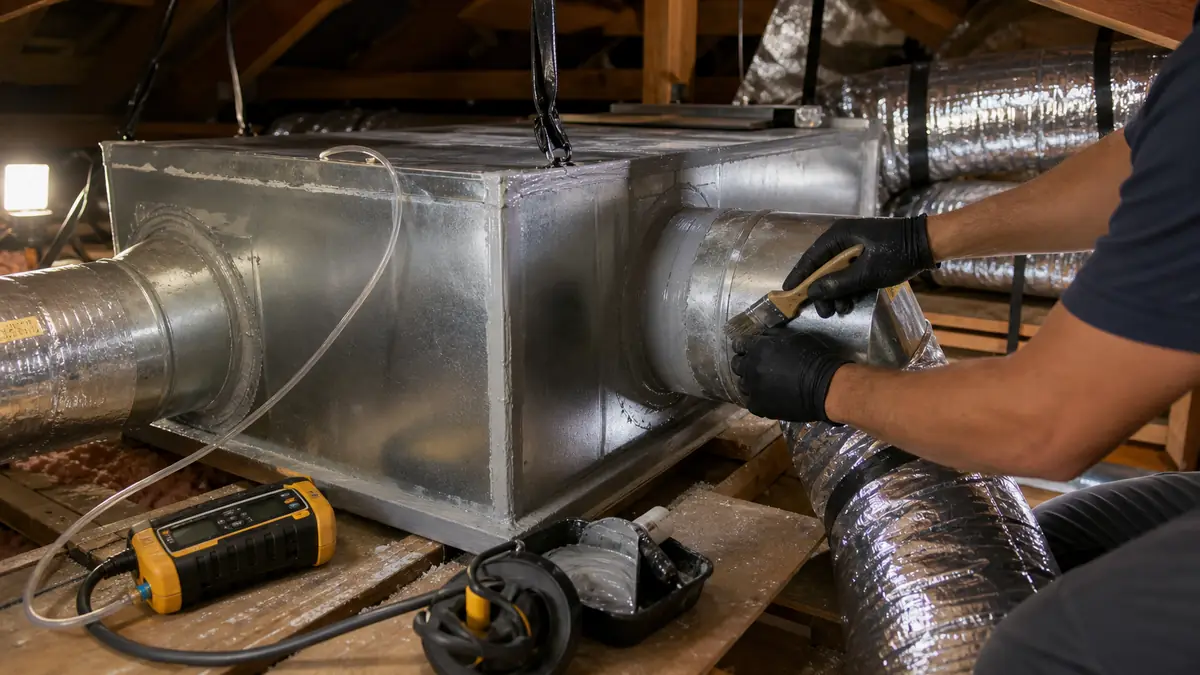
- Seal correctly: close leaks with mastic and mechanical fasteners, not cloth tape that bakes loose in a 120 F-plus attic, and re-support sagging runs.
- Replace what is failed: swap crushed or undersized sections and resize branches and returns so the blower is not fighting high static pressure that shortens its life.
- Verify and document: re-read airflow, balance dampers, and put a HERS rater on the system to log leakage for the permit and any rebate that requires it.
What does duct work cost in Pasadena, and what drives it?
Duct work spans $1,900 to $6,000, and where you land depends on scope and access. A targeted spot repair - reconnecting a dropped boot or replacing one crushed branch - sits at the bottom, $300 to $1,500. A whole-attic seal of a leaky system runs $800 to $3,500. A full duct replacement on a 2,000-square-foot home, with new insulated trunk and branches and HERS verification, reaches the top of the band.
Pasadena's older housing adds cost in specific ways. Crawlspace and low-attic access in 1900-1930 Craftsmans slows the work. Suspect asbestos duct wrap in pre-1980 homes can require abatement before anything is touched. And resizing undersized trunks and returns - not just patching leaks - is often the real fix in homes where central air was retrofitted onto a system that was never designed for it. We quote the sealing, the replacement, and a ductless alternative on the same sheet so the comparison is honest.
What does Title-24 require for duct work in Pasadena?
Under California's energy code, the 2022 cycle as updated in 2025, altering or replacing ducts usually pulls in HERS duct-leakage verification, while a new split system draws refrigerant-charge and airflow verification on top of that. Our approach is to engineer the work to pass, do the sealing, then put an independent HERS rater on it to log the leakage for the permit. Those verified leakage figures carry weight with certain rebate programs too, which the SEER2 and rebates guide spells out.
Why is duct work different in Pasadena's historic districts?
The constraints are specific to Pasadena's housing stock. Bungalow Heaven's 800-plus Craftsman homes built 1900-1930 and the 1920s Spanish revivals in Madison Heights were never designed for ducted air; the ducting was retrofitted into shallow attics and tight crawlspaces decades later, often by whoever was cheapest. That leaves long flex runs, undersized trunks, and boots barely fastened. Historic-district and HOA rules can also limit exterior changes, which steers some homes toward interior-friendly solutions. A vented attic baking past 120 F in a Zone 9 July turns every one of those leaks into cooled air the Carrier compressor has to remake, so the duct is frequently the real problem, not the equipment.
When is ductless the smarter answer?
Sometimes the duct system is so compromised, or the historic interior so unforgiving, that repairing ducts costs more than going ductless. A Carrier 37M crossover ducted mini-split runs compact, low-leakage ducts, while ductless wall heads skip ducts entirely and zone the house. We compare both against a full duct rebuild on the same quote. See heat pump installation for the retrofit paths, and weak airflow for diagnosis.
Common questions
One room in my Pasadena bungalow never cools. Is that a duct problem?
Often, yes. In 1920s homes the original ducts were added later, run long undersized branches, and leak at the boots. A back bedroom that stays warm while the hallway is cold usually means a crushed, disconnected, or undersized duct, not an undersized condenser. We measure airflow at each register before recommending equipment.
Do leaky ducts really raise my Pasadena summer bill that much?
Yes. Ducts in a vented attic can lose 20 to 30 percent of conditioned air through gaps and bad connections, and a Pasadena attic hits well over 120 F in July. That is cooled air dumped into a hot attic, so the system runs longer and the compressor wears faster. Sealing usually pays back through lower runtime.
Will sealing or replacing ducts trigger HERS testing in Pasadena?
Touch a meaningful share of the duct system, by altering or replacing it, and Title-24 generally puts you on the hook for HERS duct-leakage verification from an independent rater. We build the job to clear that test, run the sealing, and schedule the HERS check so the result is on record for the permit and for any rebate that demands verified leakage.
Can you add returns without tearing up my plaster walls?
Usually we can improve return air with high-wall or ceiling returns and a properly sized filter-back grille rather than opening every wall cavity. In tight historic interiors we sometimes recommend a ductless head or a 37M crossover system instead, which sidesteps the return-air problem entirely.
What is the difference between sealing ducts and replacing them?
Sealing closes leaks at boots, joints, and the plenum with mastic and mechanical fasteners, and it fixes most 20-30 percent attic-leakage problems for $800 to $3,500. Replacement swaps crushed, asbestos-wrapped, or hopelessly undersized runs for new insulated duct, $1,900 to $6,000. We seal where the duct is sound and replace where it is failed, rather than defaulting to the bigger job.
Is the old duct in my 1920s Pasadena attic safe to disturb?
Sometimes the original duct wrap or tape contains asbestos, which is common in pre-1980 homes. We do not cut or disturb suspect material; if testing confirms it, abatement comes first through a licensed specialist, then we install new sealed duct. We flag it on inspection rather than tearing into unknown wrap.
Will sealing my ducts actually fix a hot back bedroom?
It helps if leakage or a disconnected branch is starving that room, but airflow has to be balanced too. After sealing we re-read register airflow and adjust dampers, and we resize an undersized branch if that is the real limit. A single far bedroom on a long, skinny duct sometimes needs a larger branch or a dedicated ductless head, not just sealing.