Carrier Code 178 (Indoor Communication Fault) in Pasadena
In plain terms: A Carrier code 178 in Pasadena, CA (ZIPs 91101 to 91107) is an indoor communication fault where the Infinity control lost its link to the indoor board over the ABCD bus, so call (213) 513-5436 or book online and we will trace the four-wire bus and 24V supply.
The short version
- Code 178 is an INDOOR communication fault on a Carrier Infinity communicating system.
- The System Control touchscreen lost its data link to the indoor furnace or air-handler board.
- Carried on the four-wire ABCD bus: A and B are 24V power, C and D carry the data.
- Top causes: loose or corroded ABCD terminal, damaged comm wire, tripped condensate float, failed indoor board.
- Cost lane: wiring and float faults within a visit; an indoor control board $400-$2,000.
- Service area Pasadena ZIPs 91101-91107.
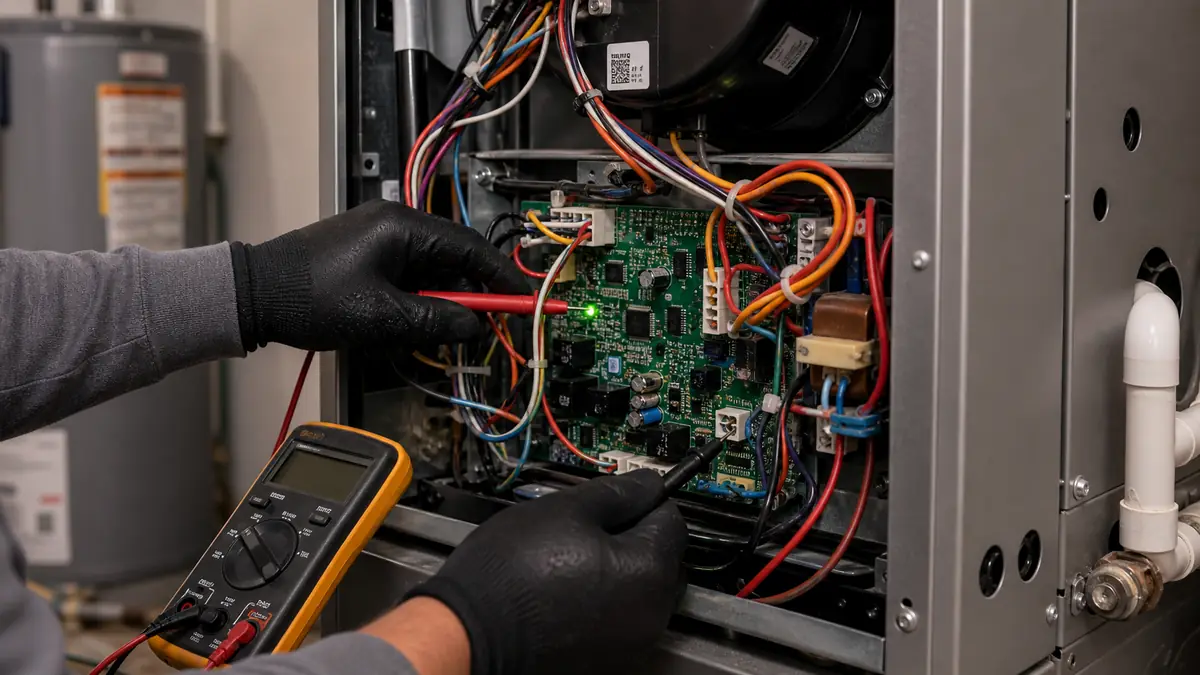
What does code 178 mean on a Carrier Infinity system?
A Carrier Infinity is a communicating system, which means the wall touchscreen and the equipment are not wired with old-school separate thermostat wires for heat, cool, and fan. Instead they share a four-wire data bus labeled A, B, C, and D. The A and B wires deliver 24-volt power, and the C and D wires carry a constant digital conversation between the System Control, the indoor furnace or fan coil board, and the outdoor unit. Code 178 means that conversation went silent on the indoor end: the touchscreen sent its messages and the indoor board stopped answering. When the link drops, the control has no way to command the blower or stage the furnace, so it shuts the system down and posts 178 rather than running blind. It is a data fault, not a mechanical one, which is why the fix usually lives in a wire, a connector, or a power supply rather than in a moving part.
Why do Pasadena homes throw a Carrier 178 code?
The cause usually traces back to where the ABCD wiring lives and how it ages. In a lot of Pasadena installs the indoor unit sits in a closet, garage, or the unconditioned attic of a remodeled Spanish or Mediterranean-revival home, and the communication wire runs a long path from a wall control near the living space. Attic heat through a Climate Zone 9 summer bakes the insulation on that wire and loosens screw terminals as the copper expands and contracts season after season, so a connection that was tight at install goes intermittent. Older Craftsman and Tudor homes in the Historic Highlands often had the comm wire fished through original wall cavities during a retrofit, where a sharp staple or a rub point can nick the conductor. The other big local driver is condensate: an Infinity furnace or fan coil ties its float switch into the 24V circuit, and when a drain clogs over a hot summer the float opens, kills power to the bus, and the touchscreen reports a communication loss that is really a plumbing problem. Rodents in older crawlspaces chewing the low-voltage jacket round out the list.
How do you diagnose a Carrier 178 fault step by step?
We work the bus from power to data. First we confirm the indoor unit actually has line power and that the blower-door interlock switch is seated, because an open door switch kills the indoor board and looks identical to a comm loss. Next we put a meter across the A and B terminals at the indoor board: we expect roughly 24 volts AC, and if it is missing we trace back to the transformer and, importantly, to the condensate float switch that is wired in series, since a tripped float is one of the most common 178 culprits in this climate. With power confirmed, we inspect every ABCD junction, the wall control, the indoor board, and any splice in between, looking for a loose screw, a corroded or backed-out connector, or a nicked conductor, and we tighten and reseat as we go. If the wiring and power check clean, we read the C-to-D data line; a communicating bus carries a measurable signal, and a flat line with good 24V points at a failed indoor control board. We only condemn the board after wiring and power are proven, because a board is the expensive answer and rarely the real one.
What can a homeowner safely check first?
You can do the outside-the-cabinet checks without any risk. Confirm the Infinity touchscreen still powers on and lights up; a dark screen often means the whole bus lost its 24V, not just data. Make sure nobody recently bumped or partly removed the furnace or air-handler service panel, since the door safety switch must be fully closed for the indoor board to run. Then look at the condensate drain and pan, because a backed-up drain trips the float switch that cuts power to the communication circuit, and clearing a visible clog can restore the link. You can also try a single, clean power cycle at the breaker, off for thirty seconds, then on, which clears a soft fault if the cause was transient. What you should not do is start unscrewing the ABCD terminals or swapping wires by trial and error; the data bus is polarity- and order-sensitive, and a miswire can turn a loose screw into a damaged board.
Is a Carrier 178 code an emergency?
It is not a safety hazard the way a combustion fault is, because nothing is burning or venting wrong, but it does leave you with no heating or cooling until the link is restored, so during a Pasadena heat wave it becomes an urgent same-day call for households with older residents, infants, or anyone heat-sensitive. An intermittent 178 that clears on a cool morning and returns on a hot afternoon is the classic sign of a heat-sensitive connection on the ABCD bus expanding open in the attic, and it is worth fixing before it fails for good in the middle of a stretch of 95-degree days. If the 178 appeared right after another contractor worked on the system or swapped a thermostat, suspect a miswired or reversed bus and have it corrected promptly, since running a miswired communicating system can stress the boards.
What gets repaired, and what does it cost?
Most 178 calls end at the cheap end. A loose or corroded ABCD terminal, a backed-out connector, or a tripped condensate float is corrected inside a standard diagnostic visit, so you pay for the trip and the fix, not a part. A damaged or rodent-chewed run of communication wire is priced by the length and access of the repair. The costly outcome, and the least common, is a failed indoor control board, which runs about $400 to $2,000 depending on whether it is a furnace control or a fan-coil board and the model generation. Because the board is the expensive answer, we prove the wiring and the 24V supply first; condemning a board before checking the float switch is how homeowners end up overpaying. If you also see a condensate or drain problem alongside the code, our water leaking page covers the float-switch side, and the full Carrier fault codes reference puts 178 in context with the 179 outdoor fault.
Common questions
What does code 178 mean on a Carrier Infinity system?
Code 178 is an indoor communication fault: the Infinity System Control touchscreen lost its data link to the indoor unit's control board over the four-wire ABCD communication bus. The thermostat and the furnace or air handler can no longer talk, so the system stops. It points at the wiring between the wall control and the indoor board, the indoor board itself, or anything that cut its 24V power, such as a tripped condensate float switch.
What is the difference between Carrier code 178 and 179?
Both are communication faults on the same ABCD bus, but they name different ends of the link. Code 178 is an INDOOR communication fault, the control lost contact with the indoor furnace or air-handler board. Code 179 is an OUTDOOR fault, the control lost contact with the condenser or heat-pump board outside. Knowing which one you have tells the tech whether to start at the indoor unit or walk out to the disconnect.
Can I fix a Carrier 178 code myself?
Start with the safe, no-tool checks. Make sure the indoor unit has power and its blower-door safety switch is fully seated, and look at the condensate pan, because a full pan trips a float switch that cuts 24V and can drop communication. Confirm the Infinity touchscreen still lights up. Beyond that, opening the unit to probe the ABCD terminals, reseat connectors, or test the board needs a meter and should go to a tech rather than guesswork.
How much does a Carrier 178 code cost to repair in Pasadena?
If it is a loose terminal, a corroded splice, or a backed-up condensate float, the fix lands inside a standard service visit. A run of damaged ABCD communication wire is priced by the repair. The expensive outcome is a failed indoor control board, which runs about $400 to $2,000 depending on the model. We always rule out wiring and power first, because most 178 faults never reach the board.